LD (Lunar Distance)
DefinitionThe term LD (Lunar Distance) denotes the average distance separating the Earth from the Moon. To quantify this measurement, we utilize a mean semimajor axis for the Moon of 384,400 km (au) to establish one LD.
What is an astronomical unit?
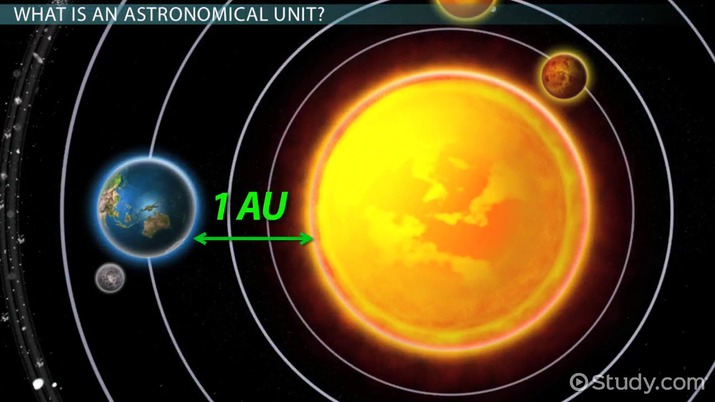
The distances within our solar system are immense. Consequently, astronomers typically refrain from expressing the distances to planets, asteroids, comets, or spacecraft in miles or kilometers. Rather, they utilize astronomical units, abbreviated as AU, which represent the average distance from the Earth to the sun. This distance is approximately 93 million miles, or 150 million kilometers, which translates to about 8 light-minutes.
Distances to the planets in AU
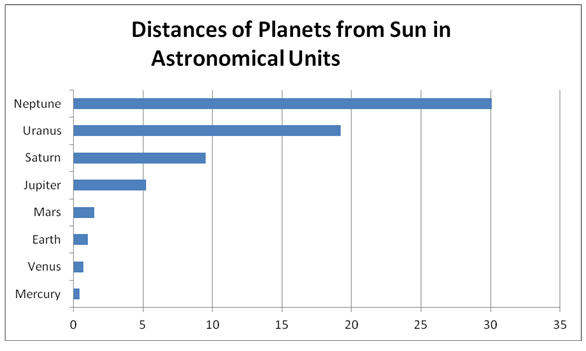
Here is the mean distance (semi-major axis) from the sun to each planet, in AU.
- Mercury: 0.387 AU
- Venus: 0.723 AU
- Earth: 1 AU
- Mars: 1.524 AU
- Jupiter: 5.203 AU
- Saturn: 9.582 AU
- Uranus: 19.201 AU
- Neptune: 30.047 AU
Units for Distance and Size in the Universe
Astronomers employ numerous units of measurement that are also utilized by other scientific disciplines. Typically, they use meters to quantify length, kilograms for mass, and seconds to measure time. Nevertheless, due to the vast distances and dimensions present in the universe, astronomers have developed additional units specifically for describing distance.
Astronomical Units:Distances within the solar system are frequently quantified in astronomical units (commonly abbreviated as AU). An astronomical unit represents the mean distance separating the Earth from the Sun:
Jupiter is located approximately 5.2 AU from the Sun, while Pluto is situated around 39.5 AU from the Sun. The distance from the Sun to the center of the Milky Way is estimated to be about 1.7 x 10^9 AU.
Light-Years:To quantify the distances separating stars, astronomers frequently employ light-years (abbreviated as ly). A light-year represents the distance that light traverses in a vacuum over the course of one year:
Proxima Centauri is the closest star to Earth (excluding the Sun) and is located 4.2 light-years away. Consequently, light from Proxima Centauri requires 4.2 years to reach Earth.
Parsecs
Numerous astronomers favor the use of parsecs (abbreviated as pc) for measuring distances to stars. This preference arises from the fact that its definition is intricately linked to a technique for gauging the distances among stars. Specifically, a parsec is defined as the distance at which 1 astronomical unit (AU) subtends an angle of 1 arcsecond.
 Image credit: Alice Hopkinson, LCO
For even greater distances, astronomers use kiloparsecs and megaparsecs (abbreviated kpc and Mpc).
Powers of Ten
The distances and dimensions of the celestial bodies that astronomers examine range from minuscule entities, such as atoms and atomic nuclei, to vast structures, including galaxies, clusters of galaxies, and the universe itself. To articulate this extensive spectrum, astronomers require a method to circumvent ambiguous expressions like "a billion trillion" and "a millionth." They employ a system known as powers-of-ten notation, which effectively consolidates all the zeros typically associated with exceedingly large or small figures, such as 1,000,000,000,000 or 0.0000000001. In this notation, all zeros are represented in an exponent, displayed as a superscript, which signifies the quantity of zeros necessary to express the number in its extended form. For instance:
- 100 = 1
- 101 = 10
- 102 = 100
- 103 = 1000
- 104 = 10,000
- and so on.
In powers-of-ten notation, numbers are expressed as a figure ranging from one to ten, multiplied by a power of ten. For instance, the distance to the Moon, which is 384,000 km, can be represented as 3.84 x 10⁵ km. It is important to note that 3.84 falls between one and ten. This same value could also be accurately expressed as 38.4 x 10⁴ or 0.384 x 10⁶, but the preferred representation is to ensure that the initial number lies between one and ten.
Additionally, very small numbers can be represented using powers-of-ten notation. In this case, the exponent is negative for values less than one, indicating division by that many tens. For example:
- 100 = 1
- 10-1 = 1/10 = 0.1
- 10-2 = 1/10 × 1/10 = 0.01
- 10-3 = 0.001
- 10-4 = 0.0001
- and so on.
Once more, numerical values are represented as a digit between one and ten, multiplied by a power of ten. For instance, a number such as 0.00000375 can be articulated as 3.75 x 10⁻⁶. can be articulated as 3.75 x 10^-6.