History of the rupee
The origins of the rupee can be traced back to ancient periods in the Indian subcontinent. The earliest known reference to rūpya appears in the works of Pāṇini, which is likely the first mention of coins in historical texts. In the Indian subcontinent, this term was utilized to denote a coin.
 Silver coin of the Maurya Empire, known as Rūpyarūpa, with symbols of wheel and elephant. 3rd century BC.
A silver coin from the Maurya Empire, referred to as Rūpyarūpa, features symbols of a wheel and an elephant, dating back to the 3rd century BC. The term "rupee" is derived from the Sanskrit word "rūpya", which translates to "wrought silver" and may also refer to something that is stamped with an image or a coin. As an adjective, it signifies "shapely", with a more precise connotation of "stamped, impressed", leading to the meaning of "coin". This term is rooted in the noun rūpa, which means "shape, likeness, image".
The Arthashastra, authored by Chanakya, who served as the prime minister to the inaugural Maurya emperor, Chandragupta Maurya (circa 340–290 BC), refers to silver coins as rūpyarūpa. It also mentions other forms of currency, including gold coins (suvarṇarūpa), copper coins (tāmrarūpa), and lead coins (sīsarūpa), although this assertion is subject to dispute. The term rūpa signifies form or shape; for instance, rūpyarūpa refers to wrought silver, while rūpa denotes form.
During the intervening periods, there was an absence of a standardized monetary system, as noted in the Great Tang Records on the Western Regions.
Sher Shah Suri, in his five-year reign from 1540 to 1545, established a new civic and military administration and introduced a silver coin weighing 178 grains, which was also referred to as Rupiya. The Mughal emperors issued coins that honored Hindu deities between 1604 and 1605.
Coins featuring Ram and Sita were minted in both silver and gold, with production ceasing immediately following Akbar's death in 1605.
The silver coin continued to circulate throughout the Mughal era, the Maratha period, and into British India. Among the earliest instances of paper rupees were those issued by the Bank of Hindostan (1770–1832), the General Bank of Bengal and Bihar (1773–75, founded by Warren Hastings), and the Bengal Bank (1784–1791).
The Indian rupee functioned as a silver-based currency for a significant portion of the 19th century, which resulted in considerable implications for its standard value, particularly as more robust economies adhered to the gold standard. Throughout the period of British colonial rule and the initial decade following independence, the rupee was divided into 16 annas, with each anna further divided into 4 pices. Consequently, one rupee equated to 64 pice (paisa) and 192 pies, given that 1 pice was equivalent to 3 pies. In 1957, a transition to decimalisation took place, leading to the rupee being divided into 100 naye paise (the Hindi/Urdu term for new paisas). After a few years, the prefix "naye" was eliminated.
For an extended period during the early to mid-20th century, the Indian rupee served as the official currency in various regions under British control, which were administered from India; these regions included East Africa, Southern Arabia, and the Persian Gulf. citation?
Early uses:
 Rupiya issued by the Sher Shah Suri, 1540–1545 CE
The term "rupee" originates from the Sanskrit word "rūpya", which translates to "wrought silver" and may also refer to an object stamped with an image or a coin. As an adjective, it signifies "shapely", specifically denoting something that is "stamped" or "impressed", hence the association with "coin". This term is derived from the noun rūpa, which in Sanskrit signifies silver.[citation needed]
Pāṇini employed the term rūpya to denote beauty or something that is struck (ahāta). The latter definition pertains to coins. Kasikakara elaborates on this, indicating that the coins which were stamped included the Dinara, Kedara, and Karshapana. The term Rupataraka is referenced by Patanjali in relation to an individual who verifies the Karshapana coins. An ancient Pali text utilizes the term Mashaka-rupa, with Mashaka representing a token Karshapana. This terminology fell out of common usage in later periods to describe a coin. In the Rajatarangini, the term rupakas is applied to gold coins, which are referred to as svarna-rupakas. The Kathasaritsagara also designates the gold Dinar coins as svarna-rupakas.
The Arthashastra, authored by Chanakya, who served as the prime minister to the first Maurya emperor Chandragupta Maurya (c. 340–290 BC), references silver coins as rūpyarūpa, while also mentioning other varieties of coins such as gold coins (suvarṇarūpa), copper coins (tāmrarūpa), and lead coins (sīsarūpa). Rūpa signifies form or shape; for instance, rūpyarūpa refers to wrought silver, and rūpa denotes.
In the interim periods, a stable monetary system is absent, as noted in the Da Tang Xi Yu Ji.
Throughout his five-year reign from 1540 to 1546, Sher Shah Suri established a new civil and military administration and introduced a silver coin weighing 178 grains, known as the Rupiya. This silver coin continued to circulate during the Mughal era, the Maratha period (1674–1818), and also in British India.
Coinage since the British period
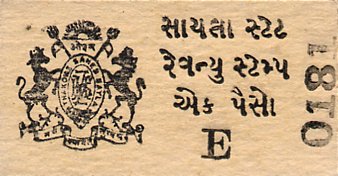 1 Paisa coupon issued by Princely State of Sayla
The British settlements in Western India, South India, and the Eastern Province of Bengal (Calcutta) independently developed different coinages in consonance with the local acceptability of the coins for the purposes of trade.
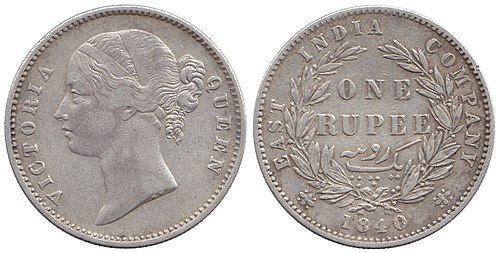 1840 East India Company rupee. It was minted in Bombay, Calcutta and Madras.
There are many fake coins of East India Company, with Indian gods depicted on the obverse side as shown in side-bar. Original East India Company coins show only the coat of arms of the East India Company.
|
Indian rupee featuring bust of George V.
|

|
|
Obverse: Profile of George V surrounded by his name.
|
Reverse: Face value, country and date.
|
|
Made of 91.7% silver.
|
The currency of Bengal was crafted in the Mughal tradition, while the coins of Madras were primarily influenced by South Indian designs. In Western India, the English coins evolved by incorporating both Mughal and English styles. It was not until AD 1717 that the British received authorization from Emperor Farrukh Siyar to mint Mughal currency at the Bombay mint. The British gold coins were referred to as Carolina, the silver coins as Anglina, the copper coins as Cupperoon, and the tin coins as Tinny. By the early 1830s, the British had established themselves as the preeminent power in India. The Coinage Act of 1835 mandated a standardized coinage system across India. The newly minted coins featured the effigy of William IV on the front and their denomination on the back in both English and Persian. Coins produced after 1840 displayed the likeness of Queen Victoria. The initial coinage under the crown was released in 1862, and in 1877, Queen Victoria adopted the title of Empress of India. During the period from 1870 to 1910, the gold-silver ratio expanded. In contrast to India, Britain adhered to the gold standard. To cover the Home Charges (i.e., expenses in England), the colonial administration was compelled to send a greater quantity of rupees due to the alteration in the ratio; this led to heightened taxation and social unrest.
 Rupee gold coin of Princely State of Bahawalpur
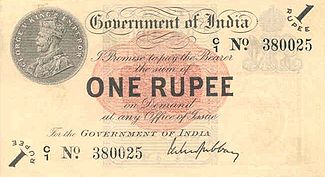 British Indian 1 rupee, 1917
The accession of King-Emperor George V to the throne in 1911 resulted in the notorious "pig rupee". On this coin, the king was depicted wearing the chain of the Order of the Indian Elephant. Due to inadequate engraving, the elephant bore a striking resemblance to a pig, which incited outrage among the Muslim community, necessitating a swift redesign of the image.
The acute scarcity of silver during the First World War prompted the issuance of paper currency in denominations of one rupee and two and a half rupees. Smaller denomination silver coins were produced in cupro-nickel. The Second World War brought about experimental changes in coinage, leading to the introduction of the "Quaternary Silver Alloy" to replace the standard rupee. Quaternary Silver coins began circulation in 1940, and by 1947, they were supplanted by coins made of pure nickel.
Following independence, the British coinage system was maintained, with the monetary framework remaining unchanged, where one rupee was equivalent to 64 pice, or 192 pies.
The "Anna Series" was launched on 15 August 1950, marking the first coinage of the Republic of India. The image of the king was substituted with the Ashoka's Lion Capital, and a corn sheaf took the place of the tiger on the one rupee coin. The monetary system continued to recognize one rupee as consisting of 16 Annas. The Indian Coinage (Amendment) Act of 1955, which came into effect on 1 April 1957, introduced a "Decimal series". Consequently, the rupee was divided into 100 'Paisa' instead of the previous divisions of 16 Annas or 64 Pice. The "Naye Paise" coins were minted in denominations of 1, 2, 5, 10, 20, and 50 Naye Paise. Both the Anna series and the Naye Paise coins remained valid for a period. Starting in 1968, the new coins were simply referred to as Paise, dropping the 'Naye' designation as they were no longer considered 'new'.Over time, considerations regarding cost and benefit resulted in the phased elimination of 1, 2, and 3 paise coins during the 1970s.
Stainless steel coins of 10, 25, and 50 paise were introduced in 1988, followed by the one rupee coin in 1992.<
The significant expenses associated with managing the issuance of ₹1, ₹2, and ₹5 notes prompted the gradual transition from notes to coins for these denominations throughout the 1990s.
In the context of World War II, Subhas Chandra Bose commanded the Indian National Army (INA), which successfully liberated Mizoram, Manipur, and portions of Nagaland from British colonial rule with assistance from Japanese forces.
During this period, the British Indian rupee was prohibited, and the Japanese rupee was introduced from 1942 to 1944.
Since 1947
Since its Independence in 1947, Indian rupee was adopted as currency in the nation. During this period almost till mid the 1960s Indian rupee was also a legal tender in Trucial States, Oman, Bahrain and Kuwait.
Decimalisation (1950s)
History of Indian Rupee (₹):
| Dates |
Currency system |
|
1850–1957
|
Rupee = 16 annas = 64 pices = 192 pies
|
|
From 1 April 1957 to 31 May 1964
|
1₹ = 100 naye paise
|
|
From 1 June 1964 till today
|
1₹ = 100 paise
|
The price of 16 Annas was 1 rupee in 1947. The demand for decimalization existed for over a century. Sri Lanka decimalised its rupee in 1869. The Indian Coinage Act was amended in September 1955 for the adoption of a decimal system for coinage. The Act came into force with effect from 1 April 1957.[12] The rupee remained unchanged in value and nomenclature. It, however, was now divided into 100 'Paisa' instead of 16 Annas or 96 paisa or 64 Pice. For public recognition, the new decimal Paisa was termed 'Naya Paisa' until 1 June 1964 when the term 'Naya' was dropped. The coins of that period also mentioned their value in terms of the rupee to avoid confusion and cheating. For example, the one paisa coin carried the text "एक रुपये का सौंवा भाग"(One hundredth of one rupee).
1966 Economic crisis
The Indian currency experienced its first devaluation in 1949, primarily due to the devaluation of the Pound sterling. However, since India's trade was predominantly conducted in Pound sterling, the impact was not as significant as the two major devaluations of the rupee that occurred in 1966 and 1991 during economic crises.
Beginning in 1950, India faced persistent trade deficits that escalated in the 1960s. Additionally, the Government of India struggled with a budget deficit and was unable to secure loans from abroad or the private corporate sector, which was hindered by a negative savings rate. Consequently, the government resorted to issuing bonds to the Reserve Bank of India (RBI), which increased the money supply and led to inflation. In 1966, foreign aid, which had previously played a crucial role in preventing the devaluation of the rupee, was abruptly terminated, and India was instructed to liberalize its trade restrictions before any foreign aid could be reinstated. This situation prompted the politically unpopular decision to devalue the currency alongside liberalization measures. Moreover, the Indo-Pakistan War of 1965 resulted in the withdrawal of foreign aid from the US and other nations allied with Pakistan, further necessitating devaluation. Defense expenditures during 1965/1966 accounted for 24.06% of total spending, marking the highest proportion from 1965 to 1989 (Foundations, pp 195). Another contributing factor to the devaluation was the drought of 1965/1966, which caused a significant increase in prices.
By the end of 1969, the Indian Rupee was valued at approximately 13 British pre-decimal pence (1s 1d), equating to Rs. 18 for £1. A decade later, in 1979, it had depreciated to around 6 British new pence (6p). Ultimately, by the conclusion of 1989, the Indian Rupee had plummeted to a then-record low of about four British pence (4p). This decline instigated a series of irreversible liberalization reforms, moving away from populist policies.
Post Bretton Woods (1970s)
Reserve Bank of India and Government of India adopted multiple adjustments to the Indian rupee following the Nixon shock of 1971 and Smithsonian Agreement. The currency gradually shifted from Par value system to pegged system and to basket peg by 1975.
1991 Economic crisis
In 1991, India maintained a fixed exchange rate system, wherein the rupee was linked to a basket of currencies from its primary trading partners. Since 1985, India had been experiencing balance of payments issues, and by the conclusion of 1990, it found itself in a precarious economic situation. The government was on the verge of default, and its foreign exchange reserves had diminished to such an extent that India could scarcely cover three weeks' worth of imports. Similar to the situation in 1966, India was grappling with high inflation and significant government budget deficits. Consequently, the government opted to devalue the rupee.
By the end of 1999, the Indian Rupee underwent a substantial devaluation.
1991 Economic crisis
Between the years 2000 and 2007, the Rupee ceased its decline and stabilized within the range of 1$ = ₹44 to ₹48. In late 2007, the Indian Rupee achieved a historic peak of 39 Indian Rupees per United States dollar, attributed to consistent foreign investment inflows into the nation. This situation created challenges for significant exporters, as well as IT and BPO companies operating within the country, which faced losses in their revenues due to the appreciation of the Rupee. However, this trend was reversed by the onset of the 2008 global financial crisis, during which foreign investors repatriated substantial amounts of capital back to their home countries. Such appreciations were evident in various currencies, including the British pound sterling, which had appreciated against the dollar before subsequently depreciating again during the recession of 2008.
2013 Depreciation
Due to a lack of effective reforms and a decrease in foreign investment, the rupee began to depreciate in early 2013. Prior to this decline, the government announced measures aimed at preventing further drops, yet none were successful in curbing the depreciation. Following ongoing depreciation and soaring inflation, the then Prime Minister of India, Manmohan Singh, addressed the issue in the Parliament of India. He expressed the opinion that the current depreciation was influenced by both global and domestic factors. Furthermore, he urged political parties to assist his Government in overcoming the crisis that the nation was experiencing due to the rupee's loss of value.
2016 Demonetisation
In 2016, the ₹500 and ₹1,000 notes were discontinued as a result of the Indian bank note demonetisation that year, leading to the introduction of a new ₹500 note and a ₹2,000 note, marking a first for the currency. Subsequently, new notes of previously existing denominations, namely ₹10, ₹20, ₹50, and ₹100, were released, while the old notes of equivalent value remained legal tender. Additionally, a ₹200 note, which is also a first for the Indian Rupee, is presently in circulation.
2023 Currency recall
In May 2023, the Reserve Bank of India commenced the process of withdrawing ₹2,000 notes from circulation. Although the ₹2,000 banknote, which was first introduced in 2016, will continue to be considered legal tender until September 2023 as per the RBI, one of the primary reasons for its removal from circulation is its low utilization rate within the current Indian market economy. Additionally, the printing of this note was halted in the fiscal years 2018 and 2019.
Revaluation (2000s)
Early paper issues
Notes issued by the Bank of Bengal can be categorised in the following three series.
-
Unifaced series
The early notes of the Bank of Bengal were printed only on one side and were issued as one gold mohur and in denominations of ₹100, ₹250, ₹500, etc.
-
Commerce series
Later notes had a vignette representing an allegorical female figure personifying 'commerce'. The notes were printed on both sides. On the obverse the name of the bank and the denominations were printed in three scripts, viz., (Urdu, Bengali and Devanagari). On the reverse of such notes was printed a cartouche with ornamentation carrying the name of the Bank.
-
Britannia series
By the late 19th century, the motif 'commerce' was replaced by 'Britannia'. The new banknotes had more features to prevent forgery.
British India issues
The Paper Currency Act,1861 gave the Government the monopoly of note issue throughout the vast expanse of British India, which was a considerable task. Eventually, the management of paper currency was entrusted to the Mint Masters, the Accountant Generals and the Controller of Currency.
-
Victoria portrait series
The first set of British India notes were the 'Victoria Portrait' series issued in denominations of ₹10, ₹20, ₹50, ₹100 and ₹1,000. These were unifaced, carried two language panels. The security features incorporated the watermark, the printed signature and the registration of the notes.
-
Underprint series
The unifaced Underprint series was introduced in 1867 as the Victoria Portrait series was withdrawn in the wake of a spate of forgeries. These notes were issued in denominations of ₹5, ₹10, ₹20, ₹50, ₹100, ₹500, ₹1,000 and ₹10,000.
-
George V series
A series carrying the portrait of George V were introduced in 1923, and was continued as an integral feature of all paper money issues of British India. These notes were issued in denominations of ₹1, ₹2+1⁄2, ₹5, ₹10, ₹50, ₹100, ₹1,000, and ₹10,000.
Reserve Bank issues during British India
The Reserve Bank of India was formally inaugurated on Monday, 1 April 1935 with its Central Office at Calcutta. Section 22 of the RBI Act, 1934, empowered it to continue issuing Government of India notes until its own notes were ready for issue. The bank issued the first five rupee note bearing the portrait of George VI in 1938. This was followed by ₹10 in February, ₹100 in March and ₹1,000 and ₹10,000 in June 1938. The first Reserve Bank issues were signed by the second Governor, Sir James Taylor. In August 1940, the one-rupee note was reintroduced as a wartime measure, as a government note with the status of a rupee coin. During the war, the Japanese produced high-quality forgeries of the Indian currency. This necessitated a change in the watermark. The profile portrait of George VI was changed to his full frontal portrait. The security thread was introduced for the first time in India. The George VI series continued till 1947 and thereafter as a frozen series till 1950 when post-independence notes were issued.
Republic of India issues
Following the Independence of India the Government of India brought out the new design ₹1 note in 1949. Initially, it was felt that the King's portrait is replaced by a portrait of Mahatma Gandhi. Finally, however, the Lion Capital of Ashoka was chosen. The new design of notes were largely along earlier lines. In 1953, Hindi was displayed prominently on the new notes. The economic crisis in the late 1960s led to a reduction in the size of notes in 1967. High denomination notes, like ₹10,000 notes were demonetized in 1978.
The first "Mahatma Gandhi Series" was introduced in 1996. Prominent new features included a changed watermark, windowed security thread, latent image and intaglio features for the visually handicapped.
The five hundred (₹500) and one thousand rupee notes (₹1,000) were demonetised by an unscheduled address to the nation by Prime Minister Narendra Modi starting from midnight 8 November 2016. These notes are being replaced by the Mahatma Gandhi New Series of notes.


 Government of India 5 Rupee note (1858)
 Hyderabad State OS Rupee 100 issue
 Five rupees, 1922
 Portuguese Indian 1 rupee, 1924
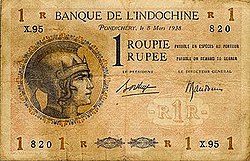 Hyderabad State OS Rupee 100 issue
 George VI profile portrait, RBI, 1937
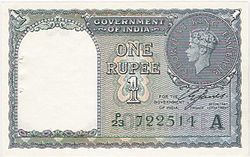 One rupee, British India
 George VI profile portrait changed to frontal portrait, RBI, 1943